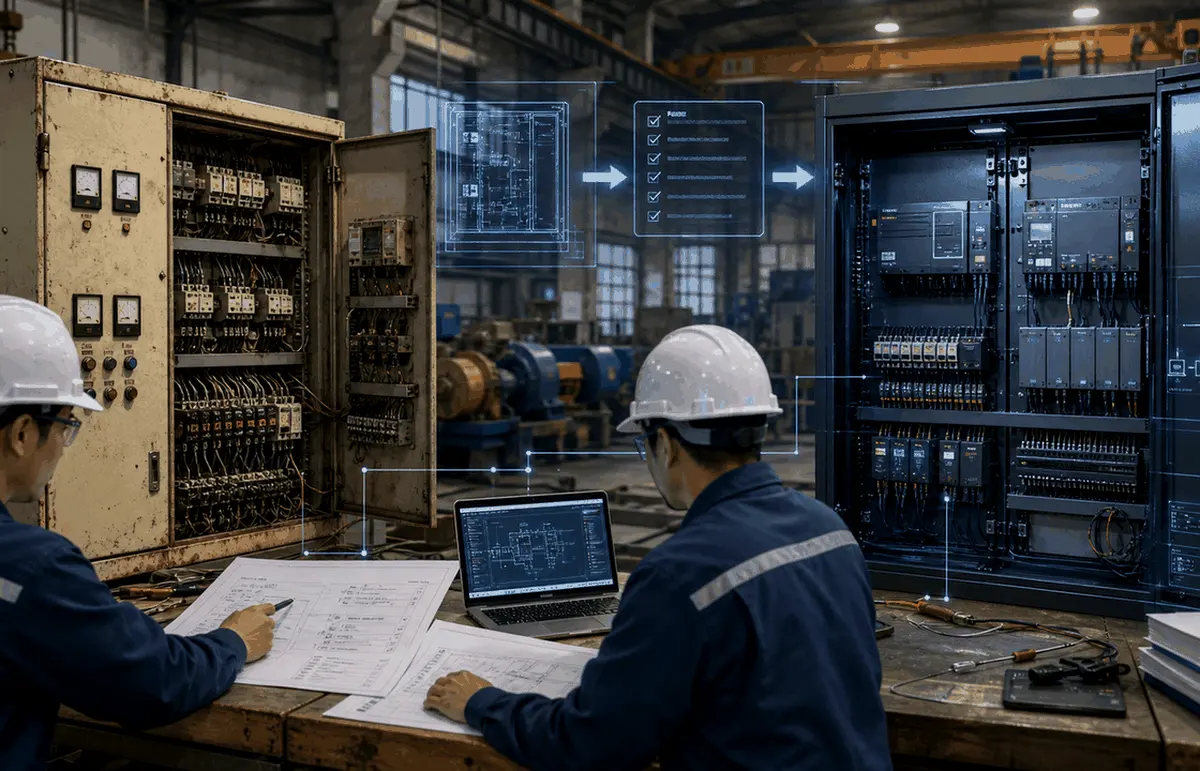
An industrial digital twin is a live, data-bound model connected to PLC/SCADA signals for monitoring, rehearsal, training and analysis, not merely a 3D visualization.
Key Questions
- What decisions must the twin support?
- Which live signals and historical data must drive the model?
- What fidelity is necessary without overbuilding the 3D model?
Implementation Path
- 1Define use cases before modelling assets.
- 2Bind the twin to PLC/SCADA data through a stable data backbone.
- 3Validate monitoring, replay, training and alarm behaviour with operators.
Related Systems and Entities
A twin is defined by purpose, not polygons
Before modelling anything, fix what decisions the twin must support — monitoring, process rehearsal, operator training or optimization. Fidelity is then scoped to those decisions, which is what keeps a twin project deliverable instead of an endless 3D exercise.
Architecture: bind the model to live data
The twin connects to live PLC/SCADA signals through the same data backbone used for monitoring and analytics. It reflects the actual running state — not a static animation — so visualization, playback and what-if all share one source of truth.
Where a twin actually helps
Live visualization of complex equipment and sites; rehearsing process changes or fault cases before touching the real plant; training operators in a sandbox that behaves like the real system; and a unified monitoring view across a smart park or factory.
Connect twin, control and remote O&M
When the twin shares the data backbone with the control system and the remote O&M platform, visualization, alarms and KPIs stay consistent from field to screen to remote support — instead of three disconnected views.
FAQ
Is a digital twin just 3D visualization?
No. Visualization is one output. A twin is bound to real-time data and used for monitoring, rehearsal, training and analysis; its value is in supporting decisions.
Can a twin be built on our existing system?
Yes. It binds to your existing PLC/SCADA data, with fidelity scoped to the decisions it must support so the project stays practical.
Digital Twin for Industrial Automation
Real-time digital twins bound to PLC/SCADA data for live visualization, process rehearsal, operator training and unified monitoring.