Digital Twin for Industrial Automation
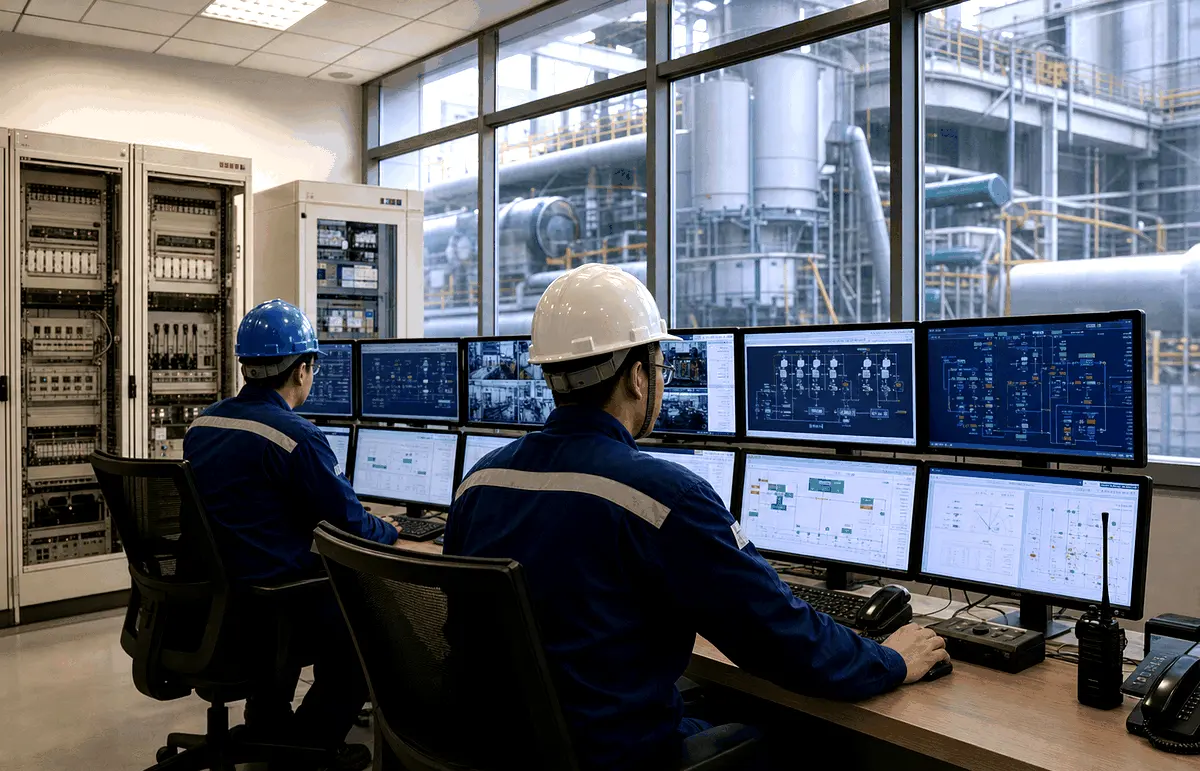
Real-time digital twins bound to PLC/SCADA data for live visualization, process rehearsal, operator training and unified monitoring.
Pain points
- Operators cannot see the whole system state in one intuitive view
- Process changes and faults are hard to rehearse safely
- Training new operators on the real plant is risky and slow
- Design, commissioning and operation data live in separate silos
Meshox solution - scope of work
Technical approach
1. Define the twin’s purpose, then its fidelity
A digital twin is not "a 3D model for its own sake". We first fix what decisions it must support — monitoring, rehearsal, training or optimization — and build only the fidelity those decisions need, so the project stays deliverable.
2. Bind the model to real-time data
The twin is connected to live PLC/SCADA signals so it reflects the actual running state, not a static animation. The same data layer feeds monitoring, playback and analytics.
3. Use it to rehearse and train
On top of the live model, what-if scenarios and fault cases can be rehearsed safely, and new operators can be trained in a sandbox that behaves like the real system — without risking the plant.
4. Connect twin, control and remote O&M
The twin shares the same data backbone as the control and remote O&M platform, so visualization, alarms and KPIs stay consistent from the field to the screen and to remote support.
Implementation scenarios
System architecture
Field Devices
Control Execution
Supervisory
Remote O&M
Applicable industries
FAQ
Is a digital twin just a 3D visualization?
No. Visualization is one output. A twin is bound to real-time data and can be used for monitoring, what-if rehearsal, training and analysis — its value is in supporting decisions, not the 3D model alone.
Can a twin be built on our existing system?
Yes. We bind the twin to your existing PLC/SCADA data. We scope fidelity to the decisions it must support so the project stays practical and maintainable.
Have a control system, retrofit or integration project?
Start with a project evaluation. An engineer will review your requirements and propose a fitting control solution.