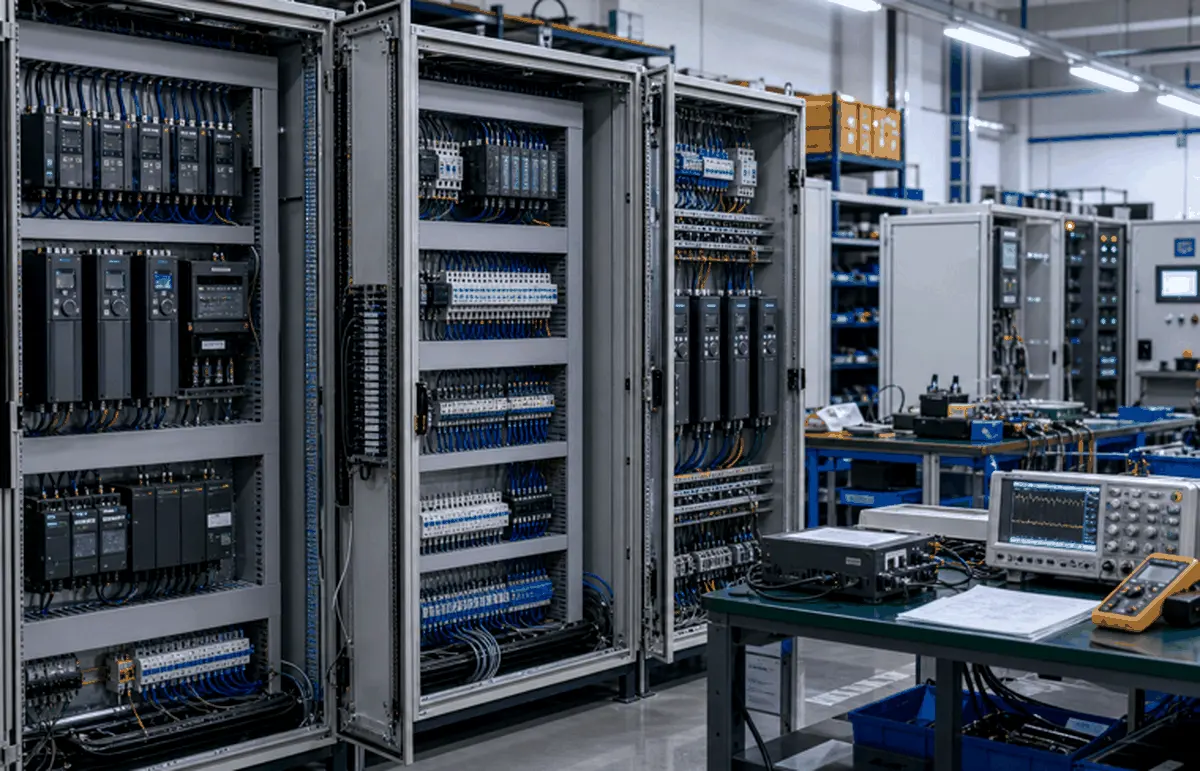
Use a soft starter when you mainly need reduced starting shock; use a VFD when the process needs speed control, energy savings or variable-torque operation.
Key Questions
- Is the load constant torque or variable torque?
- Does the process need continuous speed control?
- Are harmonics, protection and PLC/SCADA communication included?
Implementation Path
- 1Classify the motor load, duty cycle and starting requirement.
- 2Select drive capacity, protection and harmonic mitigation.
- 3Integrate control, feedback and alarms with PLC/SCADA.
Related Systems and Entities
VFD vs. soft starter: what each is for
A soft starter limits inrush and mechanical shock during start/stop but runs the motor at line frequency afterward. A VFD continuously varies speed, enabling process control and energy savings on variable-torque loads like pumps and fans.
Match the drive to the load
Load type (constant vs. variable torque), starting requirements, duty cycle and control needs drive the choice. Variable-torque loads that run at part load most of the time are where a VFD pays back fastest.
Don’t forget protection, harmonics and comms
Correct sizing, motor protection, harmonic mitigation where needed, and communication integration with the PLC/SCADA are part of a real selection — not just the kW rating.
FAQ
Is a VFD always more energy-efficient?
For variable-torque loads at part load, usually yes. For loads that always run at full speed, a soft starter may be the better, simpler choice.
Power Energy Automation & Auxiliary Control
Auxiliary control, fuel receiving, denitration, water treatment, circulating water, ash handling and digital instrumentation for power facilities.