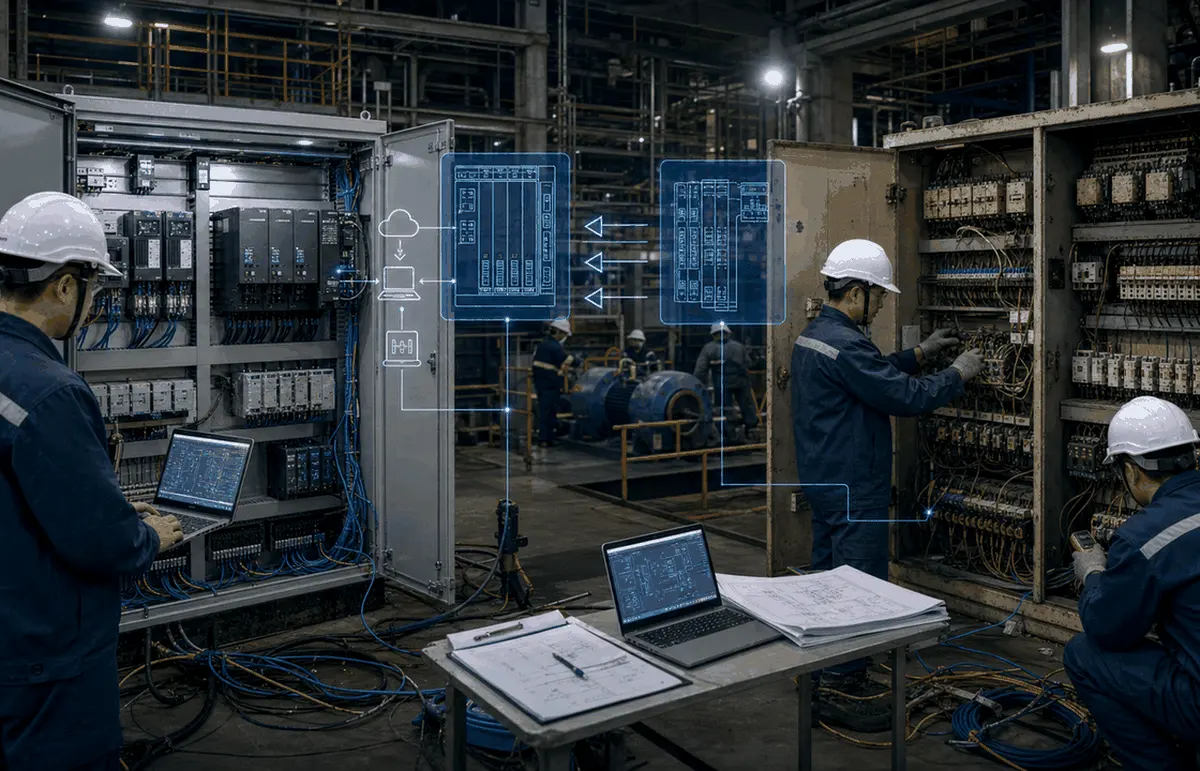
Practical industrial AI starts with trustworthy PLC/SCADA data, then applies explainable anomaly detection and selective predictive maintenance to equipment where downtime is costly.
Key Questions
- Which downtime events are expensive enough to justify prediction?
- Are the signals time-aligned, complete and meaningful?
- Who reviews AI alerts and closes the maintenance loop?
Implementation Path
- 1Build a historian and clean critical equipment data.
- 2Start with rules and anomaly detection before complex models.
- 3Connect alerts to maintenance work orders and engineer review.
Related Systems and Entities
Why most industrial AI projects disappoint
They start from the model, not the problem. Without a clean, time-aligned data foundation and a clear decision the AI must support, even good algorithms produce alerts nobody trusts. The first question is not "which model" but "which decision and on what data".
Step 1: build the data foundation
Acquire data from PLC/DCS/SCADA and instruments into a historian with a defined point list and sampling strategy. Address gaps, time alignment and units before any analytics. This step is unglamorous and decisive.
Step 2: rules and anomaly detection before heavy models
Threshold and logic rules plus statistical anomaly detection on key signals cut false alarms and surface real anomalies — and they are explainable. Much of the practical value of "AI" on site is realized here, before any deep learning.
Step 3: predictive maintenance where it pays back
For critical rotating or high-cost equipment, condition and trend models flag degradation earlier so maintenance becomes planned rather than reactive. Apply this selectively — to equipment where unplanned downtime is genuinely costly, not to everything.
Step 4: keep humans in the loop
Models produce alerts and suggestions; engineers stay in control and every output traces back to its data. Conventional interlocks and safety logic remain authoritative. This is what makes AI acceptable in an operating plant.
FAQ
Do we have to replace our control system to adopt AI?
No. AI is added as a data and analytics layer above the existing PLC/DCS/SCADA; control and safety logic stay in place.
What is a realistic first step?
A data foundation plus anomaly detection on a few critical signals — measurable, explainable, and a basis for predictive maintenance later.
Industrial Data & AI Integration
Pragmatic AI built on PLC/SCADA data: anomaly detection, smart alarms, predictive maintenance, energy analytics and AI-assisted remote diagnostics.