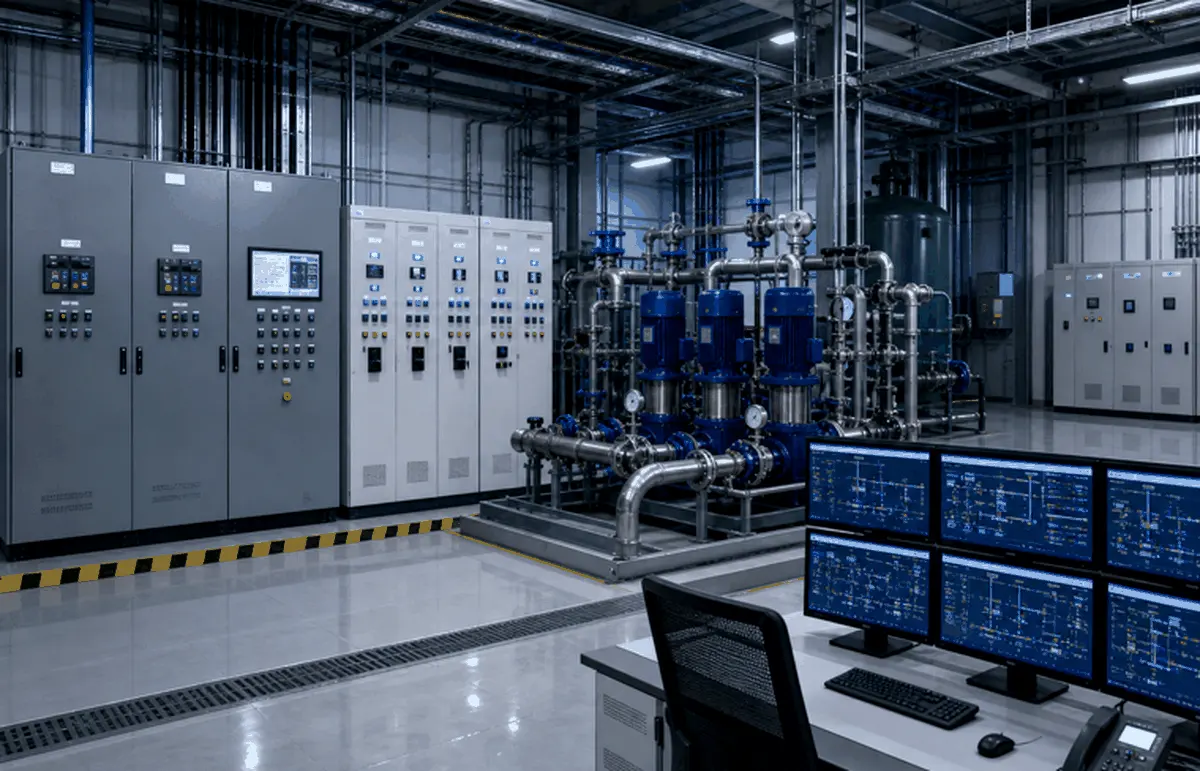
A power auxiliary control architecture should separate field devices, PLC control, HMI/SCADA supervision and DCS data exchange, with a consistent point list across coal handling, water treatment and ash handling.
Key Questions
- Which auxiliary islands must be unified under one monitoring model?
- What data must be exchanged with the main DCS?
- How will alarms, reports and operation responsibility be standardized?
Implementation Path
- 1Inventory auxiliary systems and existing controller platforms.
- 2Define common I/O, alarm and communication conventions.
- 3Integrate SCADA reporting and DCS interface tests before handover.
Related Systems and Entities
Why auxiliary systems need a deliberate architecture
Auxiliary systems are often built area by area over years, ending up isolated, with inconsistent control logic and incomplete data sharing. A deliberate architecture treats them as one monitored estate rather than separate islands.
Field, control and supervisory layers
At the field layer are motors, valves, instruments and meters; the control layer uses PLC controllers and panels for interlock and protection; the supervisory layer provides HMI/SCADA monitoring, alarms and reporting. Clear layering keeps each part maintainable.
Data sharing with the DCS and management systems
A common gap is that auxiliary data does not reach the DCS or management systems cleanly. Defining communication interfaces and a consistent point list early lets the plant share operating data without custom one-off bridges.
Maintainability over cleverness
Auxiliary control logic should be standardized and documented so maintenance does not depend on one engineer’s memory. This is usually more valuable than squeezing out marginal optimization.
FAQ
Can auxiliary systems be retrofitted without touching the main DCS?
Yes. Auxiliary control can be upgraded and then interfaced to the DCS through defined communication points, keeping the main control system stable.
Power Energy Automation & Auxiliary Control
Auxiliary control, fuel receiving, denitration, water treatment, circulating water, ash handling and digital instrumentation for power facilities.