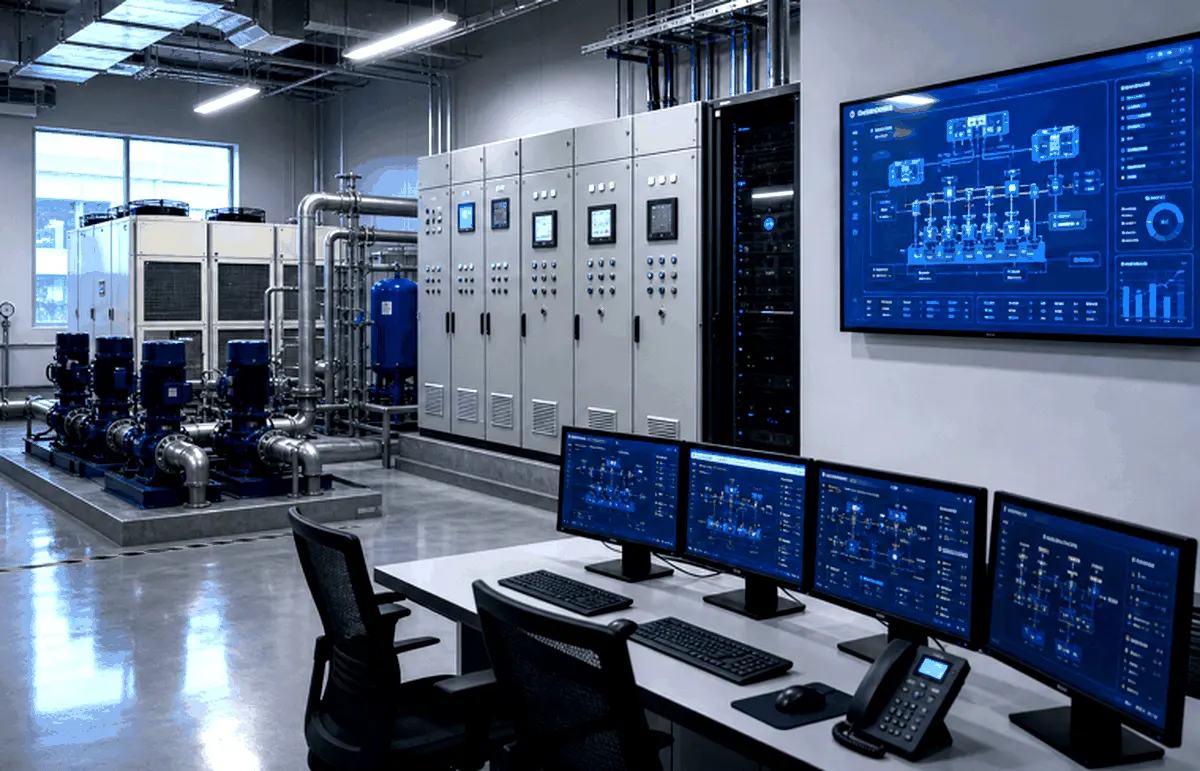
PLC controls equipment, DCS controls large continuous processes, and SCADA supervises data, alarms and visualization; in real projects they often coexist.
Key Questions
- Is the project a machine, a plant-wide process or a monitoring layer?
- How many loops, sites and operators are involved?
- Which layer owns control authority and which layer only supervises?
Implementation Path
- 1Separate control requirements from visualization requirements.
- 2Choose PLC or DCS based on process scale and continuity.
- 3Use SCADA for alarms, trends, reporting and remote visibility.
Related Systems and Entities
PLC: fast, discrete control at the equipment level
A PLC (Programmable Logic Controller) executes deterministic control logic close to the equipment — interlocks, sequences, motion, protection. It is the workhorse for machine and process control where fast, reliable response matters.
DCS: plant-wide continuous process control
A DCS (Distributed Control System) is built for large, continuous processes with many control loops — typical in power and petrochemical plants. It emphasizes integrated control, redundancy and operations across the whole plant rather than a single machine.
SCADA: supervision, data and visualization
SCADA (Supervisory Control and Data Acquisition) sits above controllers: it collects data, visualizes state, logs history, manages alarms and enables remote monitoring across distributed sites. SCADA supervises; PLC/DCS control.
How to choose — they usually coexist
In practice a project combines them: PLCs (or a DCS for large continuous processes) do control, SCADA supervises and reports. The right scope depends on process size, continuity, number of sites and how much remote visibility you need.
FAQ
Do I need both a PLC and SCADA?
Often yes: PLCs handle control, SCADA handles supervision, data and remote monitoring. Small standalone machines may need only a PLC and HMI.
Is DCS always better than PLC?
No. DCS suits large continuous processes; PLC suits fast discrete and machine control. The better choice depends on the process, not on which is "higher-end".
Industrial Software, Remote O&M & Legacy Upgrade
Remote service, SCADA access, smart factory visualization, energy management and practical upgrades for aging control systems.