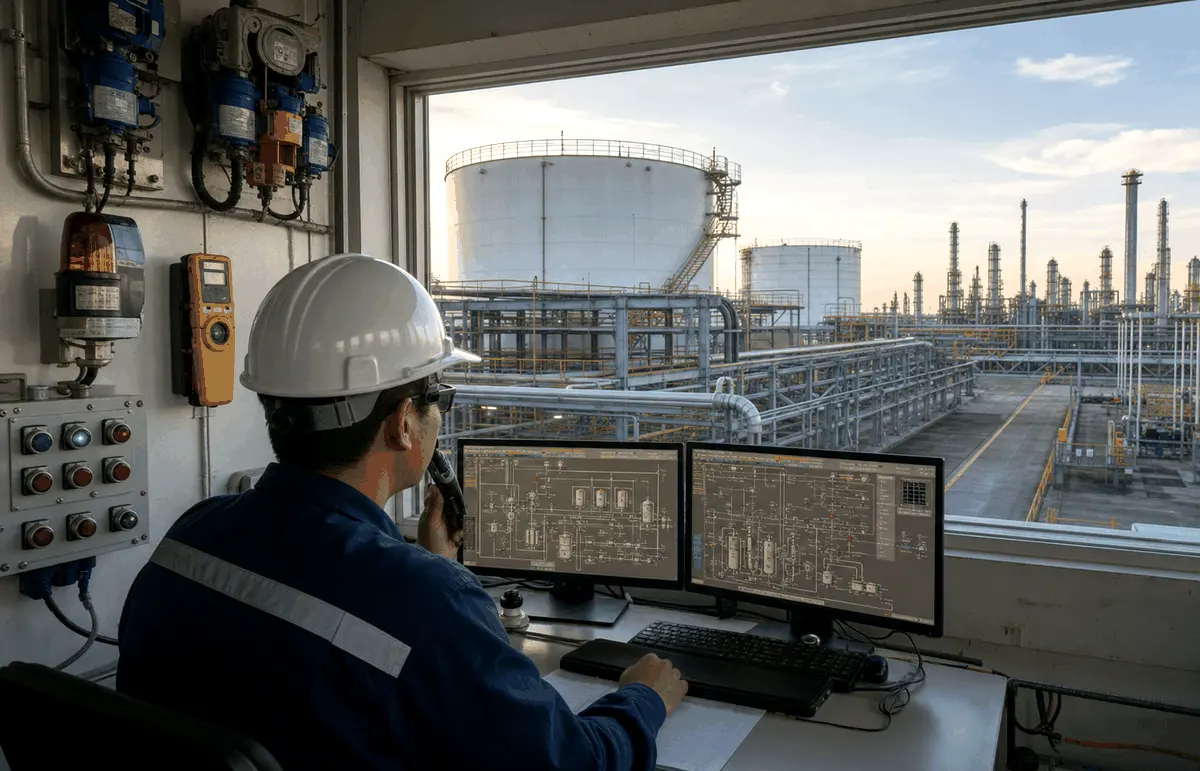
Tank farm safety monitoring combines level, pressure, temperature, combustible gas detection, safety interlocks, SCADA alarms and traceable inventory data.
Key Questions
- Which tank signals are safety-critical and need redundancy?
- How do gas alarms and SIS or interlock logic act on abnormal states?
- How are metering, inventory and operation records retained?
Implementation Path
- 1Confirm instrument ranges, hazardous-area requirements and alarm thresholds.
- 2Test gas detection, safety interlocks and SCADA alarm handling.
- 3Build traceable reports for storage operation and audit.
Related Systems and Entities
Measure level, pressure and temperature reliably
Tank level, pressure and temperature are the base signals. Instrument selection and redundancy where required determine whether downstream alarms and reports can be trusted.
Combustible gas alarm and safety interlock
Combustible gas detection and safety interlock logic (including SIS where applicable) must respond reliably. This logic is part of the control scope, designed and tested rather than added as an afterthought.
Metering, inventory and traceability
Electronic metering and inventory data support storage operation and audit. Traceable records reduce reliance on manual reporting and make review possible.
SCADA visualization for the whole farm
A SCADA platform consolidates tank parameters, alarms and reports into one view, replacing scattered local stations and slow manual reporting.
FAQ
Is safety interlock part of the monitoring system?
Yes. Combustible gas alarms and safety interlock logic are designed and tested as part of the tank farm control scope.
Petrochemical Instrumentation & Safety Monitoring
SIS, tank farm monitoring, combustible gas alarm, electronic metering supervision and storage operation visualization.