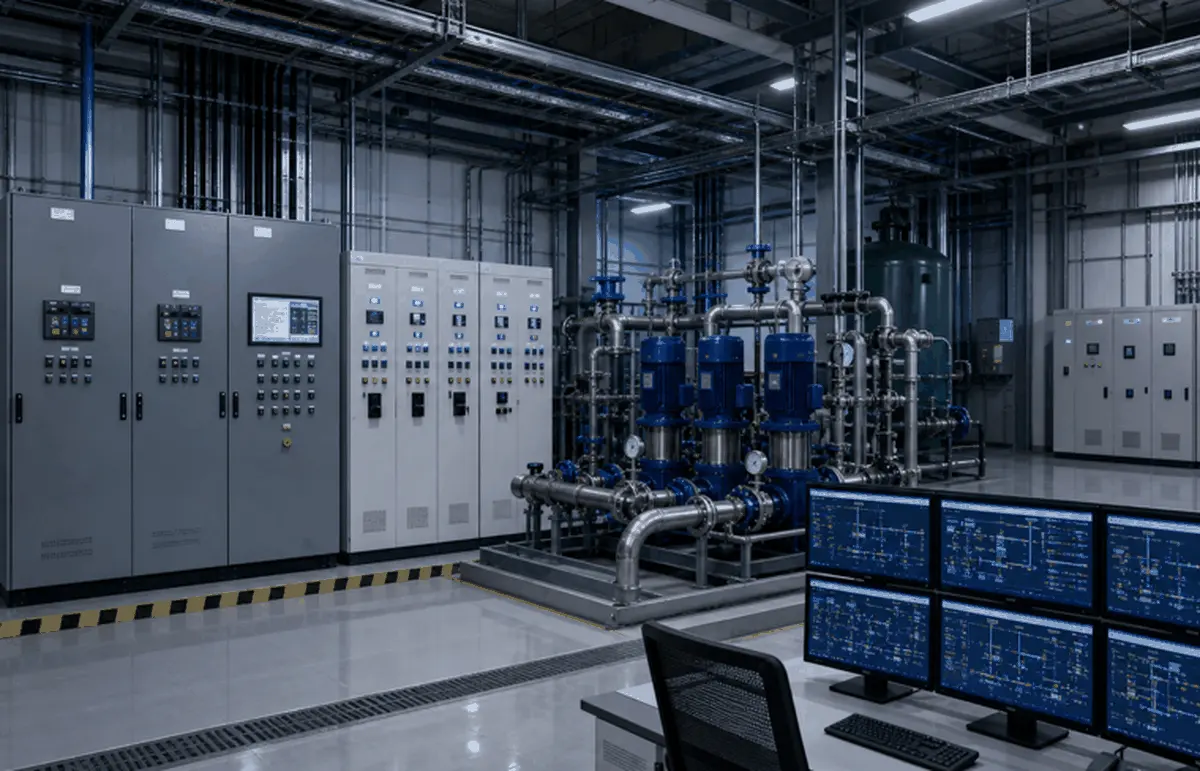
MCC automation integrates motor starters, protection, VFDs, local/remote control, PLC interlocks, SCADA status and maintenance diagnostics into one motor-control architecture.
Key Questions
- Which motors need remote control and diagnostics?
- Which signals must remain hardwired for safety?
- How will trips, runtime and starts be recorded?
Implementation Path
- 1Define start method, protection and local/remote mode for each motor.
- 2Integrate commands, feedback and alarms into PLC and SCADA.
- 3Record runtime, starts, trips and diagnostic data for maintenance.
Related Systems and Entities
Define motor control requirements
Each motor should have a defined start method, protection requirement, local/remote mode, feedback signals, interlocks and maintenance isolation strategy.
Integrate MCC with PLC and SCADA
PLC logic controls permissives and sequences; SCADA displays status, alarms, runtime and fault records. Communication and hardwired safety signals must be planned together.
Design for maintenance diagnostics
Useful MCC automation records trip reason, running hours, starts, load condition and device status. These signals help maintenance teams find problems before repeated trips interrupt production.
FAQ
Should MCC data be connected to SCADA?
Yes when the motors are important to production or utilities. Status, fault and runtime data improve operation and maintenance.
Is VFD control part of MCC automation?
Often yes. VFD panels may be separate or integrated, but their status, commands and alarms should be part of the same control architecture.
Power Energy Automation & Auxiliary Control
Auxiliary control, fuel receiving, denitration, water treatment, circulating water, ash handling and digital instrumentation for power facilities.